




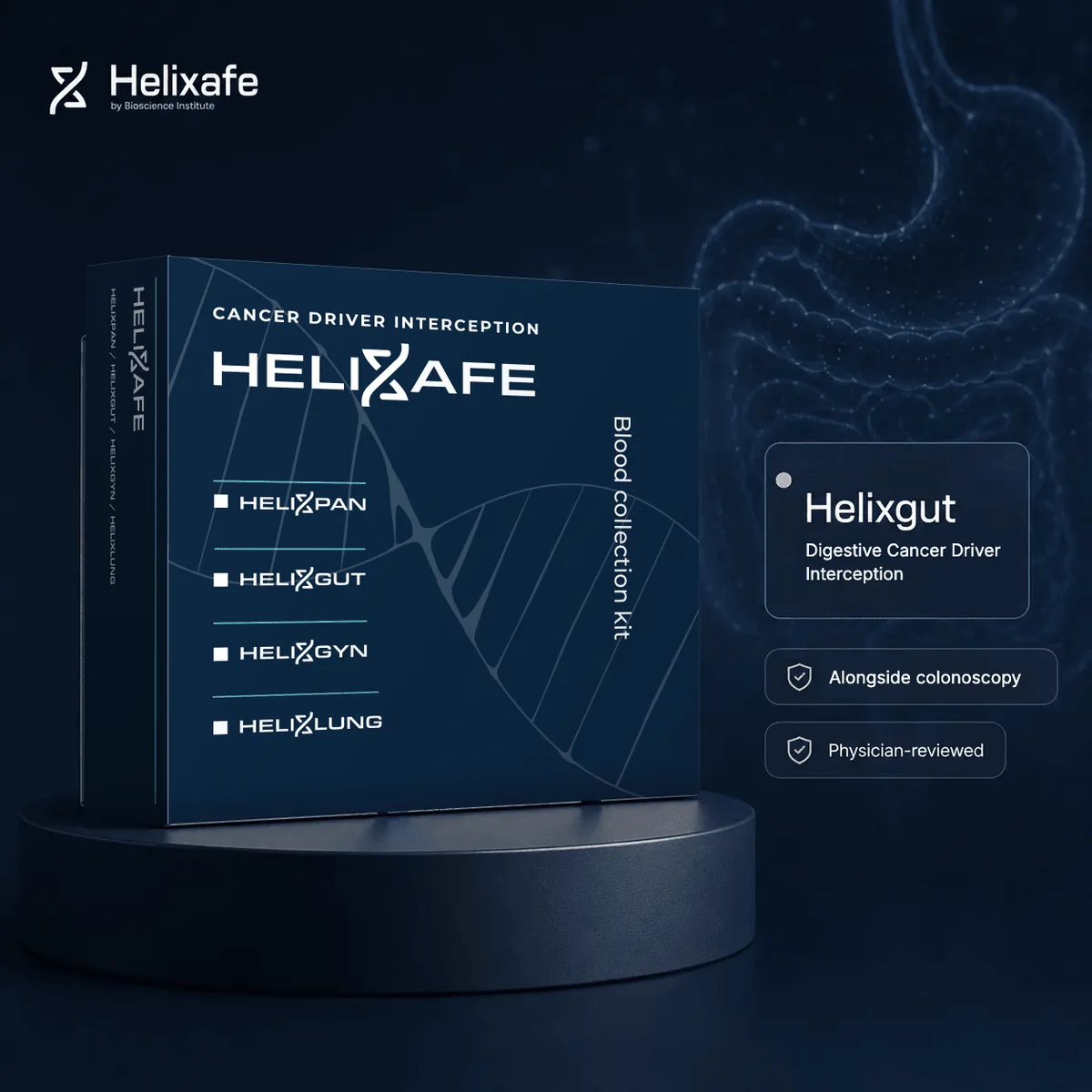
Digestive Cancer Driver Interception
HELIXGUT
Available in the US from October 16
- Prescribed and reviewed by physicians
- Home kit or partner location
- Your report within 8 weeks, explained
After colon cancer, polyps or Barrett's: follow what is changing in your blood between scopes.
HELIXGUT is a physician-guided blood test that follows the cancer drivers of the colon, stomach, esophagus, pancreas, liver and biliary tract in the cell-free DNA of your blood. It is for people who came through a digestive cancer or live with a condition a specialist watches. Your first test sets your reference; the next ones show what is changing between scopes.
Is HELIXGUT for you?
HELIXGUT is for people whose digestive tract already has a follow-up plan, or a good reason for one. If one of these sounds like you, it was built with your situation in mind.
I came through colon or another digestive cancer
Your scopes, scans and markers stay exactly as planned. In between, HELIXGUT gives you and your physicians a reading of the digestive drivers in your blood.
I live with Barrett's, reflux or gastritis
Upper endoscopy keeps watching the lining of your esophagus and stomach. HELIXGUT follows the drivers linked to those tissues in the months between.
I've had polyps removed, or I have IBD
Polyps taken out, Crohn's or colitis under follow-up: your next colonoscopy is already booked. HELIXGUT reads the colon drivers in your blood until then.
I have a pancreatic cyst or IPMN
Your cyst is followed with MRI or endoscopic ultrasound. HELIXGUT adds a reading of the pancreatic drivers in your blood between one scan and the next.
I have hepatitis B or C, or fatty liver
Long-term hepatitis or MASH keeps your liver under regular review. HELIXGUT follows the liver and bile duct drivers in your blood alongside those checks.
Digestive cancer runs in my family
You already know why you pay attention. HELIXGUT shows what is changing in your own digestive biology now, next to the colonoscopies recommended for you.
A third question
Two kinds of test are familiar. One tells you what you inherited. The other looks for cancer that is already there. HELIXAFE sits between them and asks something neither was built to answer.
- Hereditary testing
What did I inherit?
Reads the variants you were born with, such as BRCA1 or Lynch syndrome genes. The answer is fixed for life, so it is usually tested once.
- HELIXAFE
What is changing now?
Reads acquired driver changes in your blood, then reads them again, so you get a reference first and a direction after.
- Screening
Is there cancer to find?
Mammograms, colonoscopies, CT scans and other exams look for cancer, or precancer, that is already there.
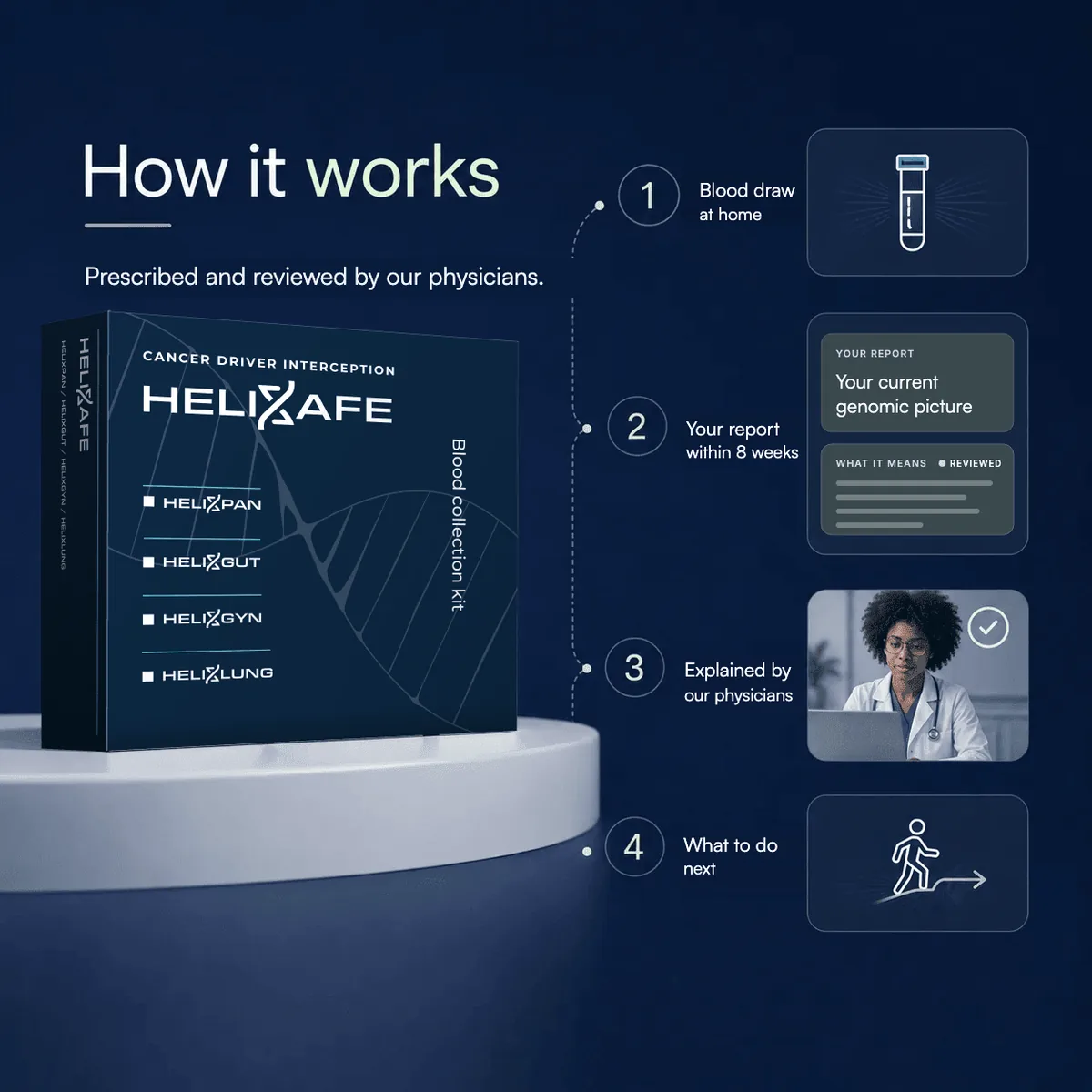
How it works
- 1
Answer a short questionnaire
Choose your application, then share your health and family history in a short online questionnaire.
- 2
A physician prescribes
A Bioscience Institute physician reviews your answers and, if the test fits, prescribes it. Your kit ships overnight.
- 3
One blood draw
Use the kit at home, or visit a partner location. The sample then travels to a CLIA/CAP-certified laboratory.
- 4
Your report, explained
Within 8 weeks, with physicians and genomic counselors who explain each finding and what comes next.
What HELIXGUT follows
Cancer drivers are gene changes that can push a cell toward cancer. HELIXGUT reads 14 genes at 246 mutational hotspots, the spots where those changes most often appear in digestive tissue. One blood draw is read across the whole digestive system.
- The polyp-to-cancer path
- Colon cancer usually grows out of a polyp over years. HELIXGUT follows the gene changes that mark the steps along that path.
- Esophagus and stomach
- Drivers linked to Barrett's esophagus and chronic gastritis, the conditions your upper endoscopies keep an eye on.
- Pancreas, cysts and IPMN
- Changes associated with pancreatic cysts and IPMN, read from your blood rather than from an image.
- Liver and bile ducts
- Drivers relevant to long-term hepatitis B or C, fatty liver (MASH) and cancers of the biliary tract.
- Real signal, not noise
- A confirmation step helps set a genuine signal apart from random background before anything reaches your report.
Your first HELIXGUT test is your reference: where your digestive drivers stand today. Repeat tests, through Continue Interception, are set beside it, so you see a direction rather than a snapshot. Stable is a result in its own right. A change is a reason to talk with your physicians, not a verdict.
Between one scope and the next
Colonoscopy and upper endoscopy look at the lining directly. CT, MRI and ultrasound show the pancreas and liver. These exams look for cancer, or precancer, that is already there, and HELIXGUT replaces none of them. It works in the months between, reading what is changing in your blood. Keep every recommended screening and follow-up, exactly as scheduled.
What you receive
Your blood draw kit
Shipped overnight anywhere in the US, with what you need for a draw at home. Prefer a partner location? That works too.
Laboratory analysis
Your cell-free DNA is read with next-generation sequencing in a CLIA/CAP-certified laboratory, on the panel you chose.
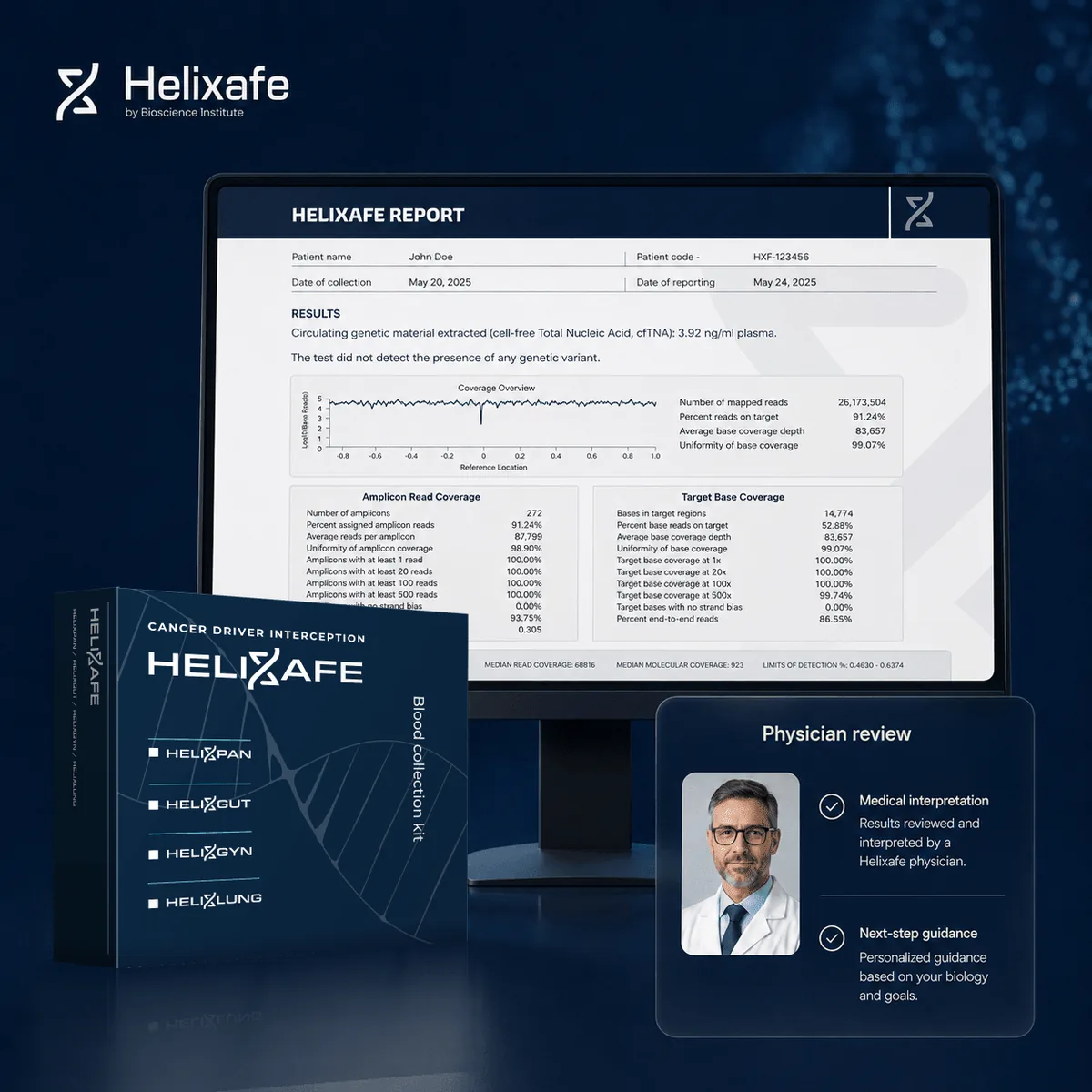
A structured report
Within 8 weeks: which acquired changes are present in the genes your application reads, and how strong each signal is.
Physician and genomic counselor review
Bioscience Institute physicians and genomic counselors review your result and explain it against your personal and family history.

What HELIXAFE is not
- Not a replacement for any exam. Keep every recommended screening and follow-up, exactly as scheduled.
- Not a cancer verdict. A result does not tell you whether you have cancer; it is information your physicians help you use.
- Not a look at what you inherited. It reads changes acquired during life, not the variants you were born with.
- Not for under-18s or without a prescription. For adults 18 and over, prescribed and reviewed by Bioscience Institute physicians.
Questions people ask
Can HELIXGUT be my blood test after colon cancer?
Yes, if you are 18 or over and our physician confirms it fits your history. After treatment, HELIXGUT reads the colon and other digestive drivers in your blood between your scheduled checks. It sits next to your colonoscopies, CT scans and CEA tests and replaces none of them. Your oncologist's plan stays exactly as it is.
Does HELIXGUT replace my colonoscopy?
No. A colonoscopy looks at the colon directly and can remove a polyp on the spot. A blood test can do neither. Keep every colonoscopy and upper endoscopy exactly when your gastroenterologist schedules it, whatever your HELIXGUT result shows.
Is HELIXGUT another stool test?
No. Stool tests look for signs of colon cancer or polyps that are already there. HELIXGUT is a blood test. It reads acquired gene changes in cell-free DNA across the whole digestive system and follows them over time. It answers a different question: what is changing now?
Can HELIXGUT help with Barrett's esophagus monitoring?
It adds to it. Your endoscopies and biopsies remain how Barrett's is watched. Between them, HELIXGUT reads the esophageal and stomach drivers in your blood and shows whether they hold steady or shift from one test to the next. Your gastroenterologist decides what, if anything, to do with that information.
I have a pancreatic cyst. Is HELIXGUT for me?
It can be. If an IPMN or another cyst is followed with MRI or endoscopic ultrasound, HELIXGUT adds a reading of the pancreatic drivers in your blood between scans. It cannot tell you what the cyst is or whether it needs surgery. Those decisions stay with your specialist and your imaging.
What does a positive HELIXGUT result mean?
It means acquired changes were found in one or more of the genes HELIXGUT reads, and the report shows how strong each signal is. That is not the same as having cancer. Our physicians and genomic counselors explain it against your history. If it calls for a closer look, they tell you what to raise with your gastroenterologist or refer you to a specialist.
Should I choose HELIXGUT or HELIXPAN?
If your history is digestive, HELIXGUT is the focused choice: 14 genes and 246 hotspots chosen for the colon, stomach, esophagus, pancreas, liver and biliary tract. If your history, or your family's, spans more than one organ system, HELIXPAN reads across tissues. Our physician reviews your questionnaire either way.
When should I repeat HELIXGUT?
When your report recommends it. Your first result is your reference, and your physicians suggest when the next reading makes sense for you. Repeat tests are ordered as Continue Interception and are always read against your earlier results, so you and your physicians can see how things are moving.
The science behind it
HELIXAFE grows out of Bioscience Institute's work on cell-free DNA, the small fragments of DNA that cells release into the blood. Its peer-reviewed research on cell-free DNA in healthy people, published in 2019, underpins how HELIXAFE reads acquired changes. The platform is patent-protected, and every sample is analyzed in a CLIA/CAP-certified laboratory.
For healthcare professionals
Request the clinician briefPanel specifications and clinical indications for each application, for physicians and genetic counselors.
Patient? Switch viewHELIXGUT is an advanced molecular monitoring program designed for early interception of colorectal cancer.
HELIXGUT analyzes 246 hotspot regions across 14 key genes implicated in colorectal tumorigenesis, enabling periodic monitoring of somatic mutation frequencies and genomic stability—two of the most reliable early indicators of cancer development. By identifying subtle alterations in mutational burden over time, the program can reveal an increased risk of colorectal cancer long before symptoms appear or before traditional diagnostic tools can identify lesions.
This longitudinal genomic surveillance provides a proactive approach to interception, offering a measurable advantage in identifying cancer predisposition years ahead of conventional early-diagnosis pathways.
Indications
The HELIXGUT monitoring program is indicated for individuals who wish to assess their genomic stability over time by analyzing mutation frequencies in genes known to play a central role in colorectal tumorigenesis. Through periodic molecular evaluation, HELIXGUT allows healthy subjects to identify early signs of genomic instability—an objective biomarker that may precede the onset of colorectal cancer long before clinical symptoms or identifiable lesions appear.
HELIXGUT is recommended for individuals who fall into one or more of the following categories:
- Adults over 45–50 years of age seeking early molecular indicators of colorectal cancer risk.
- Individuals with a family history of colorectal cancer or adenomatous polyps.
- Subjects with chronic inflammatory bowel diseases (ulcerative colitis, Crohn’s disease).
- People with lifestyle-related risk factors, including high intake of processed/red meat, low fiber diet, obesity, or sedentary lifestyle.
- Current or former smokers, given the mutational impact of tobacco carcinogens on gastrointestinal tissues.
- Individuals exposed to environmental or occupational carcinogens, such as industrial chemicals or persistent air pollution.
- Those who wish to complement conventional screening, such as the fecal occult blood test, with a genomic approach capable of identifying prodromal alterations.
- Anyone interested in a proactive strategy for Colorectal Cancer Interception, based on annual monitoring of somatic mutation frequencies.
What the test evaluates
The HELIXGUT test evaluates genomic instability by monitoring the frequency of somatic mutations across 14 key genes and 246 hotspot regions involved in colorectal cancer development. By quantifying these acquired mutations, the test can identify early molecular alterations that characterize the prodromal, asymptomatic phase of solid tumors—long before clinical signs or identifiable lesions appear.
| 14 Genes | |
|---|---|
| AKT1 | KRAS |
| BRAF | MAP2K1 |
| CTNNB1 | NRAS |
| EGFR | PIK3CA |
| ERBB2 | SMAD4 |
| FBXW7 | TP53 |
| GNAS | APC |
| 246 HOTSPOTS | |
|---|---|
| KRAS/NRAS: | G12/G13/Q61 |
| BRAF: | V600E |
| PIK3CA: | E545K, H1047R |
| TP53: | R175H, R273H/C/L |
| APC: | Recurring pathogenic mutations (incl. p.R876*, p.Q1378*, p.R1450*) |
| SMAD: | R361C/H |
| CTNNB1: | S45F, T41A |
An innovative model
HELIXGUT represents a modern approach to colorectal cancer interception, based on the objective evaluation of somatic mutations rather than on subjective or family-based risk assessments. Using liquid biopsy and Next Generation Sequencing (NGS), the test identifies and quantifies acquired mutations across genes involved in colorectal tumorigenesis, capturing early genomic instability—one of the earliest measurable indicators associated with the development of colorectal cancer.
Its true strength lies in its annual repetition, which allows continuous monitoring of mutation frequencies over time. By comparing molecular data year after year, HELIXGUT provides a dynamic and precise view of genomic stability, enabling the early identification of emerging alterations and supporting a more personalized and proactive interception strategy.
How the test is performed
Bioscience Institute offers pre-test advice and provides all useful information about the interception program and the execution of the HELIXGUT test.
The test involves a simple blood sample that can be performed at one of our reference centers or through your doctor.
The Bioscience Institute laboratories extract the DNA present in the sample and sequence it using the advanced Next Generation Sequencing (NGS) techniques. The subsequent bioinformatics analysis allows the determination of the presence of any mutations in the genes under examination.
Test results are available in approximately 30 days.
Scientific content reviewed by the Bioscience Institute Scientific Board. · Last updated
The information on this page is for general education and does not replace a consultation with a physician.