




Cancer Driver Interception
HELIXAFE
One blood test, four applications: follow what is changing in your blood between your checks.

HELIXAFE is a physician-guided blood test that reads acquired cancer driver changes in the cell-free DNA of your blood and follows them over time. It comes in four applications: HELIXPAN across tissues, HELIXGUT for the digestive tract, HELIXLUNG for the lungs and HELIXGYN for breast and gynecologic organs. Each works between your checks and replaces none of them.
Choose your application

Multi-Cancer Driver Interception
HELIXPAN
After prostate, blood, skin or urinary cancer, for family histories across organs, or for the broadest view.
Explore HELIXPAN
Digestive Cancer Driver Interception
HELIXGUT
After a digestive cancer, or with Barrett's, polyps, IBD, a pancreatic cyst, hepatitis or fatty liver.
Explore HELIXGUT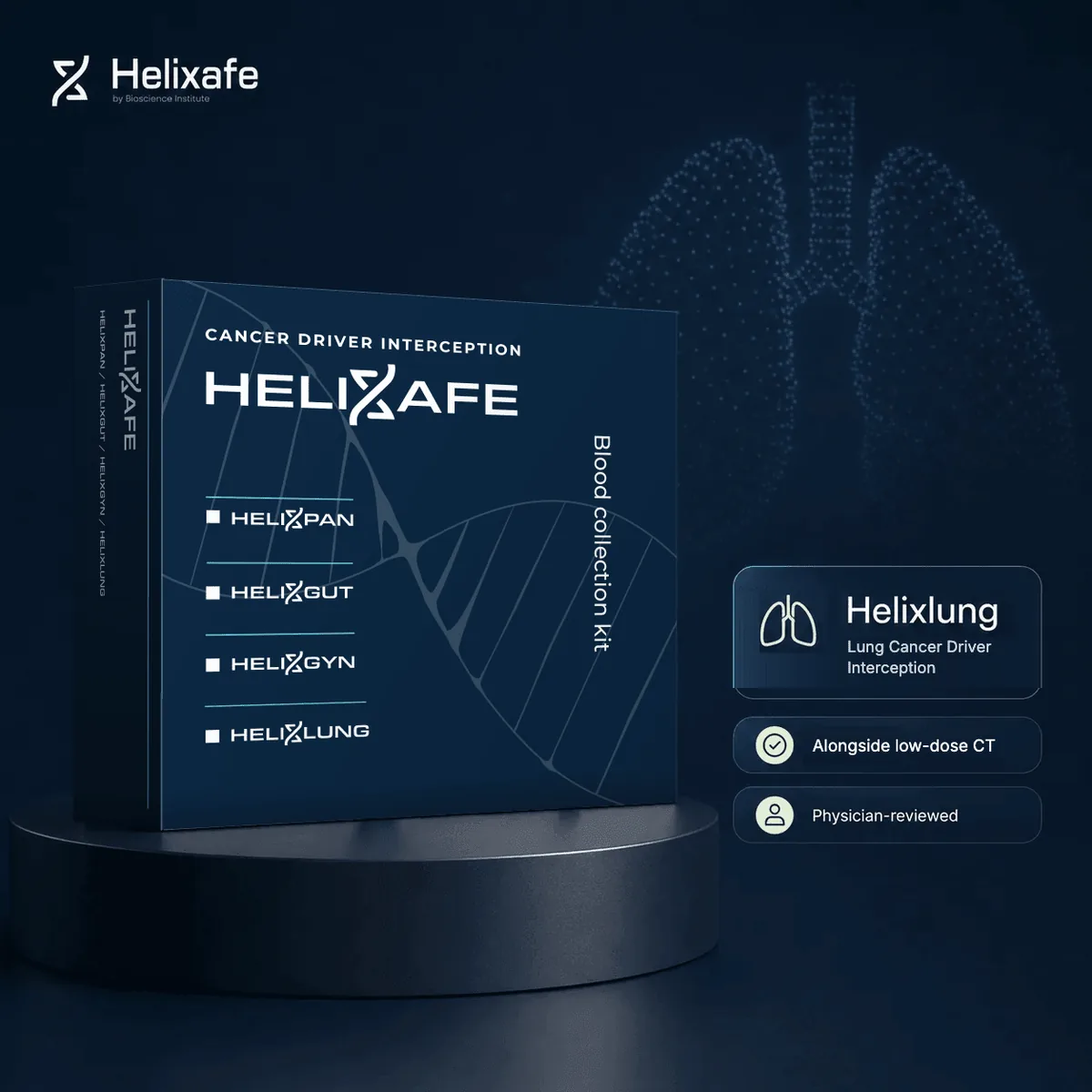
Lung Cancer Driver Interception
HELIXLUNG
After lung cancer, with a nodule under follow-up, as a current or former smoker, or with exposure or COPD.
Explore HELIXLUNG
Breast & Gynecologic Cancer Driver Interception
HELIXGYN
After breast or ovarian cancer, as a BRCA or PALB2 carrier, or with dense breasts or a lesion on watch.
Explore HELIXGYNAvailable in the US from October 16
Not sure where to start?
- I came through colon, stomach or pancreatic cancerHELIXGUT HELIXGUT follows the digestive drivers in your blood between your scopes and scans.
- I came through breast or ovarian cancerHELIXGYN HELIXGYN reads breast and gynecologic drivers, including ESR1, the signal of resistance to hormone therapy.
- I came through lung cancer, or a nodule on my CT is being followedHELIXLUNG HELIXLUNG reads the main lung drivers in your blood in the months between CT scans.
- I came through prostate, blood or skin cancerHELIXPAN No organ application focuses there. HELIXPAN reads drivers across tissues.
- I have Barrett's, polyps or a pancreatic cystHELIXGUT Your specialist watches the finding. HELIXGUT follows the digestive drivers behind it, in your blood.
- Cancer runs in my family across several organs, or I'm not sureHELIXPAN When nothing points to one organ, start broad. Our physician reviews your questionnaire first.
A third question
Two kinds of test are familiar. One tells you what you inherited. The other looks for cancer that is already there. HELIXAFE sits between them and asks something neither was built to answer.
- Hereditary testing
What did I inherit?
Reads the variants you were born with, such as BRCA1 or Lynch syndrome genes. The answer is fixed for life, so it is usually tested once.
- HELIXAFE
What is changing now?
Reads acquired driver changes in your blood, then reads them again, so you get a reference first and a direction after.
- Screening
Is there cancer to find?
Mammograms, colonoscopies, CT scans and other exams look for cancer, or precancer, that is already there.
How it works
- 1
Answer a short questionnaire
Choose your application, then share your health and family history in a short online questionnaire.
- 2
A physician prescribes
A Bioscience Institute physician reviews your answers and, if the test fits, prescribes it. Your kit ships overnight.
- 3
One blood draw
Use the kit at home, or visit a partner location. The sample then travels to a CLIA/CAP-certified laboratory.
- 4
Your report, explained
Within 8 weeks, with physicians and genomic counselors who explain each finding and what comes next.

The four applications side by side
| Application | HELIXPAN | HELIXGUT | HELIXLUNG | HELIXGYN |
|---|---|---|---|---|
| Right for you if… | Your history spans several organs, or none of the others | Your history is digestive, or your gastroenterologist watches a condition | You came through lung cancer, have a nodule, smoke or were exposed | You came through breast or ovarian cancer, or carry known risk |
| Follows | Cancer drivers across tissues | Colon, stomach, esophagus, pancreas, liver and biliary tract | Lung cancer drivers | Breast, ovarian and gynecologic drivers, including ESR1 |
| Panel | 52 genes · 900+ point mutations · 99 gene fusions · 12 copy number alterations | 14 genes · 246 mutational hotspots | 11 genes · 169 mutational hotspots | 10 genes · 157 mutational hotspots |
| Works alongside | Age-based screenings, PSA tests, skin checks, oncology follow-up | Colonoscopy, upper endoscopy, CT, MRI, ultrasound | Low-dose CT, follow-up CT, PET-CT | Mammography, breast MRI, ultrasound, CA-125 |
| To start | One blood test | One blood test | One blood test | One blood test |
| Your report | Within 8 weeks, with physician review | Within 8 weeks, with physician review | Within 8 weeks, with physician review | Within 8 weeks, with physician review |
Questions people ask
Is there a blood test that can monitor my cancer risk over time?
Not as a single risk number. What HELIXAFE does is read the acquired cancer driver changes in your blood, then read them again later. The first test is your reference; each repeat shows whether the picture is stable or shifting. That direction, explained by our physicians, is what you follow over time.
How is HELIXAFE different from cancer screening?
Screening looks for cancer that is already there, or for changes visible in tissue, such as a polyp or a shadow on a scan. HELIXAFE asks a third question: what is changing now? It reads acquired driver changes in your blood between those exams. Keep every recommended screening and follow-up, exactly as scheduled.
What happens after I order?
First, a short online health questionnaire. One of our physicians reads it and decides whether the test suits you; if it does, they write the prescription. The kit goes out overnight to any US address. Your blood is drawn at home or at a partner site, then analyzed in a CLIA/CAP-certified laboratory. The report follows within 8 weeks.
What does my report show?
It lists the acquired changes found in the genes your application reads, with the strength of each signal. Bioscience Institute physicians and genomic counselors take you through it, relate it to your history and tell you what to raise with your own doctors. If a result calls for a closer look, they refer you to a specialist.
Is my genetic information kept private?
Yes. The laboratory works to CLIA/CAP-certified protocols, and your report is treated as confidential health information, like any clinical lab result. The people who review it with you are Bioscience Institute physicians and genomic counselors.
Who can order HELIXAFE?
Adults 18 and over in the United States, for now. Every test is prescribed and reviewed by Bioscience Institute physicians after an online health questionnaire. Outside the US it is not available yet, and more regions will follow.
Which application for which patient
All four applications run on one test: cell-free DNA sequenced by NGS from a single blood draw, on fixed, application-specific panels. Each is prescribed after an online questionnaire and reviewed by our physicians and genomic counselors. None replaces guideline-based screening or surveillance.
| HELIXPAN |
| Age-appropriate screening, PSA and urologic follow-up, hematology follow-up with blood counts, dermatologic examination and survivorship imaging. |
|---|---|---|
| HELIXGUT |
| Colonoscopy, upper endoscopy with biopsy, endoscopic ultrasound, CT or MRI, liver ultrasound and CEA, at guideline intervals. |
| HELIXLUNG |
| Low-dose CT screening, nodule follow-up CT, PET-CT and post-treatment surveillance imaging. |
| HELIXGYN |
| Mammography, breast MRI and ultrasound, pelvic examination, transvaginal ultrasound, CA-125 and oncology follow-up. |
Panels at a glance
| HELIXPAN | 52 genes · 900+ point mutations · 99 gene fusions · 12 copy number alterations | One blood draw (cfDNA, NGS) · home kit or partner location | Within 8 weeks · physician and genomic counselor review |
|---|---|---|---|
| HELIXGUT | 14 genes · 246 mutational hotspots · colon, stomach, esophagus, pancreas, liver, biliary tract | One blood draw (cfDNA, NGS) · home kit or partner location | Within 8 weeks · physician and genomic counselor review |
| HELIXLUNG | 11 genes · 169 mutational hotspots · lung | One blood draw (cfDNA, NGS) · home kit or partner location | Within 8 weeks · physician and genomic counselor review |
| HELIXGYN | 10 genes · 157 mutational hotspots · breast, ovarian, gynecologic · includes ESR1 | One blood draw (cfDNA, NGS) · home kit or partner location | Within 8 weeks · physician and genomic counselor review |
Intercepting Cancer Before It Develops
HELIXAFE represents a revolutionary approach to cancer interception through the continuous monitoring of key biological drivers that precede cancer development. Rather than identifying cancer after it has formed, HELIXAFE intercepts the conditions that enable cancer to arise.
Modern oncology research has identified four critical biological imbalances that create the environment for cancer development: chronic inflammation, microbiome dysbiosis, genomic instability, and immune system dysfunction. When these conditions persist over time, they significantly increase cancer risk.
The HELIXAFE protocol provides comprehensive, periodic monitoring of these four cancer drivers through specialized diagnostic tests. By tracking changes in these biomarkers over time, we can identify concerning trends early and implement targeted interventions before cancer has a chance to develop.
The Four Cancer Drivers We Monitor
Scientific research has established clear links between these biological conditions and cancer development. HELIXAFE monitors each driver through dedicated diagnostic protocols.
Genomic Instability
The main macroenvironment driving genomic instability in cancer
Accumulating DNA mutations and chromosomal aberrations are hallmarks of cancer initiation.
Microbiome Dysbiosis
Pathogenic bacteria produce carcinogenic metabolites and significantly impair immune surveillance.
Chronic Inflammation
Pro-inflammatory cytokines create a tumor-promoting microenvironment and DNA damage.
Immune Dysfunction
Weakened immune surveillance allows pre-cancerous cells to escape identification and elimination.
The clinical utility of the HELIXAFE protocol was demonstrated in a study published in the scientific journal Cell Death & Disease by an international group of experts coordinated by researchers from Bioscience Genomics, a spin-off jointly owned by the University of Rome “Tor Vergata” and Bioscience Institute.
The HELIXAFE protocol was presented during a Consensus Conference held at the Senate of the Italian Republic. Read the White Paper.
HELIXAFE Diagnostic Protocols
Each HELIXAFE protocol is designed to comprehensively assess one of the four cancer drivers through advanced biomarker analysis and cutting-edge diagnostic technologies.

HELIXPAN
Genomic Instability Monitoring – Liquid biopsy with circulating cell-free total nucleic acid (cfTNA) analysis using Next Generation Sequencing (NGS)
CYTOBALANCE
Pro-inflammatory Cytokine Monitoring – Comprehensive analysis of inflammatory biomarkers including IL-2, IL-6, IL-10, TNF-α and more.
MICROBALANCE
Gut and Vaginal Microbiome Assessment – Advanced metagenomic sequencing to evaluate microbial composition and identify dysbiosis patterns.
HELIXBALANCE
Genome Instability Monitoring – Liquid biopsy analysis identifying circulating tumor DNA, chromosomal aberrations and mutation signatures.
IMMUNEBALANCE
Immune System Balance Analysis – Complete immunophenotyping and functional assessment of innate and adaptive immune responses.
Explore Each Protocol in Detail
Click on each protocol to learn more about the biomarkers analyzed, testing methodology, and clinical significance.
HELIXPAN - Genomic Instability Monitoring
Test Type: Liquid biopsy with circulating cell-free total nucleic acid (cfTNA) analysis using Next Generation Sequencing (NGS)
Description:
HELIXPAN is designed to identify genomic instability through peripheral blood analysis, monitoring the progressive accumulation of genetic mutations that characterize the prodromal phase of solid tumor development. By analyzing circulating nucleic acids (DNA and RNA) extracted from plasma, HELIXPAN identifies somatic mutations in both tumor suppressor genes and driver genes, assessing their effectiveness in preserving genomic stability and intercepting cancerous transformation.
Analysis Components:
- 52-Gene Comprehensive Panel: Including critical tumor suppressors (TP53, APC, PTEN, SMAD4, FBXW7, CHEK2) and oncogenic drivers
- Over 900 SNVs Identification: Single nucleotide variations and small insertions/deletions (indels) in hotspot regions
- 99 Gene Fusions: Analysis of 12 genes for chromosomal rearrangements (ALK, ROS1, RET, NTRK1, NTRK3, FGFR1-3, BRAF, ERG, ETV1, MET)
- 12 CNV-Gains: Copy number amplifications in key oncogenes (EGFR, ERBB2, MET, FGFR1-3, MYC, CCND1-3, CDK4-6)
- TP53 Deep Sequencing: Coverage of ~80% of TP53 gene with identification of de novo non-hotspot variants (≥1% allelic frequency)
- MET Exon 14 Skipping: Specific assessment of this critical splicing mutation
- Ultra-Sensitive Identification: Variants identified with allelic frequency >0.1% under optimal conditions
Key Genes Analyzed:
Hotspot genes: APC, AKT1, ALK, AR, ARAF, BRAF, CHEK2, CTNNB1, DDR2, EGFR, ERBB2, ERBB3, FBXW7, ESR1, FGFR1-4, FLT3, GNA11, GNAQ, GNAS, HRAS, IDH1-2, KIT, KRAS, MAP2K1-2, MET, MTOR, NRAS, NTRK1, NTRK3, PDGFRA, PIK3CA, PTEN, RAF1, RET, ROS1, SF3B1, SMAD4, SMO, TP53
Clinical Significance:
Progressive accumulation of somatic mutations identified by serial HELIXPAN testing indicates persistent tumor suppressor gene inactivation and increasing genomic instability—the hallmark of pre-cancerous transformation. Early identification enables targeted interventions including gene therapy, DNA demethylating agents, and personalized interception strategies before clinical cancer develops. The test is particularly valuable for longitudinal monitoring of healthy individuals at risk, tracking tissue progression from normal to precancerous states.
CYTOBALANCE – Pro-inflammatory Cytokine Monitoring
Target: Chronic low-grade inflammation (Inflammaging)
Test Type: Blood serum analysis with multiplex cytokine assay
Description:
CYTOBALANCE provides a comprehensive assessment of the inflammatory status by measuring key pro-inflammatory and anti-inflammatory cytokines. Chronic inflammation is recognized as a major driver of cancer development, creating a microenvironment that promotes tumor initiation and progression.
Clinical Significance:
Elevated inflammatory markers indicate increased cancer risk and guide targeted anti-inflammatory interventions. Serial monitoring tracks treatment response and identifies emerging inflammation patterns.
MICROBALANCE – Gut and Vaginal Microbiome Assessment
Target: Microbiome dysbiosis and pathogenic colonization
Test Type: Metagenomic sequencing of stool and/or vaginal samples
Description:
MICROBALANCE uses advanced next-generation sequencing to comprehensively characterize the gut and vaginal microbiome. Dysbiosis has been linked to multiple cancer types including colorectal, gastric, and cervical cancers through mechanisms involving inflammation, metabolite production, and immune modulation.
Clinical Significance:
Identifies cancer-promoting bacterial signatures and guides targeted probiotic/prebiotic interventions. Vaginal microbiome assessment is particularly relevant for cervical cancer risk stratification.
HELIXBALANCE – Genome Instability Monitoring
Target: DNA damage, mutations, and chromosomal aberrations
Test Type: Liquid biopsy with circulating cell-free DNA analysis
Description:
HELIXBALANCE employs cutting-edge liquid biopsy technology to identify signs of genomic instability before cancer develops. By analyzing cell-free DNA fragments circulating in the bloodstream, we can identify mutation signatures, chromosomal copy number variations, and methylation changes indicative of pre-cancerous processes.
Clinical Significance:
Provides the earliest possible identification of genomic changes that precede cancer formation. Enables risk stratification and guides proactive interventions at the molecular level.
IMMUNEBALANCE – Immune System Balance Analysis
Target: Immune dysfunction and immunosenescence
Test Type: Flow cytometry immunophenotyping and functional assays
Description:
IMMUNEBALANCE provides a comprehensive evaluation of immune system status, assessing both innate and adaptive immunity. Immune surveillance is critical for eliminating pre-cancerous cells, and age-related immune decline (immunosenescence) significantly increases cancer risk.
Clinical Significance:
Identifies immune deficiencies that impair cancer surveillance and guides immunomodulatory interventions. Essential for monitoring immune reconstitution and optimizing immune health.
The Cancer Driver Interception Approach
HELIXAFE represents a paradigm shift from reactive cancer identification to proactive cancer interception. Our integrated approach combines regular monitoring with personalized intervention strategies.
Continuous Monitoring
Regular periodic testing tracks biomarker trends over time, identifying concerning changes before they become clinical problems.
Personalized Intervention
Based on your unique biomarker profile, we develop targeted strategies using nutraceuticals, lifestyle modifications, and advanced therapies.
Outcome Tracking
Follow-up assessments measure intervention effectiveness and consistently adjust protocols based on your body’s individual response to treatment.
HELIXAFE integrates seamlessly with Bioscience Institute’s NGTX food supplements (CYTOXAFE, BIOXAFE, MYCROGENOX, GENEXAFE) and advanced therapeutic services. When biomarker imbalances are identified, targeted interventions can be implemented immediately, creating a closed-loop system for cancer interception and optimal health maintenance.
Also in the HELIXAFE program
Four BALANCE kits sit alongside the four applications. Each has its own page explaining what it looks at and how to order it.
Cancer driver interception
Request information
Tell us your situation and a specialist from this area will get back to you, in your country and your language.
HELIXAFE reads biological drivers over time; it is not a diagnostic test and does not replace the screening programmes recommended for your age.
Prefer WhatsApp? WhatsApp us (Boston, United States)