





Breast & Gynecologic Cancer Driver Interception
HELIXGYN
Available in the US from October 16
- Prescribed and reviewed by physicians
- Home kit or partner location
- Your report within 8 weeks, explained
After breast or ovarian cancer: follow what is changing in your blood between one visit or scan and the next.
HELIXGYN is a physician-guided blood test that follows the drivers of breast, ovarian and gynecologic cancers in the cell-free DNA of your blood, including ESR1, the signal of resistance to hormone therapy. It is for women who came through breast or high-grade serous ovarian cancer, and for women with known risk. It works between visits and scans, never instead of them.
Is HELIXGYN for you?
HELIXGYN is for women already living with a breast or gynecologic follow-up plan, or with a clear reason to have one. Find the situation closest to yours.
I came through breast cancer
Mammograms, MRI and oncology visits continue as planned. If you take hormone therapy, HELIXGYN also reads ESR1, the gene where resistance to that therapy can show.
I came through ovarian cancer
After high-grade serous ovarian cancer, HELIXGYN follows TP53 and the other drivers on its panel between your CA-125 tests and scans.
I carry BRCA1, BRCA2 or PALB2
You know what you inherited, and HELIXGYN does not test it again. It reads the changes your cells acquire over life, alongside your MRI and specialist plan.
My doctor is watching a breast lesion
Atypical hyperplasia or another lesion on watch: imaging keeps following it. HELIXGYN follows the breast drivers in your blood in the time between.
I have dense breasts
Dense tissue can make a mammogram harder to read, so you may already have ultrasound or MRI. HELIXGYN adds a molecular reading between those appointments.
Hormones or my reproductive history add risk
Hormone replacement therapy, a late menopause, no pregnancies: HELIXGYN gives you a reading of what is changing now, not a risk score.
A third question
Two kinds of test are familiar. One tells you what you inherited. The other looks for cancer that is already there. HELIXAFE sits between them and asks something neither was built to answer.
- Hereditary testing
What did I inherit?
Reads the variants you were born with, such as BRCA1 or Lynch syndrome genes. The answer is fixed for life, so it is usually tested once.
- HELIXAFE
What is changing now?
Reads acquired driver changes in your blood, then reads them again, so you get a reference first and a direction after.
- Screening
Is there cancer to find?
Mammograms, colonoscopies, CT scans and other exams look for cancer, or precancer, that is already there.
How it works
- 1
Answer a short questionnaire
Choose your application, then share your health and family history in a short online questionnaire.
- 2
A physician prescribes
A Bioscience Institute physician reviews your answers and, if the test fits, prescribes it. Your kit ships overnight.
- 3
One blood draw
Use the kit at home, or visit a partner location. The sample then travels to a CLIA/CAP-certified laboratory.
- 4
Your report, explained
Within 8 weeks, with physicians and genomic counselors who explain each finding and what comes next.

What HELIXGYN follows
Cancer drivers are gene changes that can push a cell toward cancer. HELIXGYN reads 10 genes at 157 mutational hotspots chosen for breast, ovarian and gynecologic tissue. It includes ESR1, where resistance to hormone therapy can begin.
- ESR1 and hormone therapy
- If you take tamoxifen or an aromatase inhibitor, ESR1 is where resistance to that treatment can begin. HELIXGYN follows it from one test to the next.
- TP53, a central brake
- A tumor suppressor gene at the heart of high-grade serous ovarian cancer and of triple-negative breast cancer.
- PIK3CA and AKT1
- Growth-signal genes often involved in hormone receptor-positive breast cancer.
- HER2 and CDK amplification
- Extra copies of growth genes that can push breast cells to keep dividing.
- Real signal, not noise
- A confirmation step sets genuine signal apart from background, which matters after chemotherapy, when blood cells can carry changes of their own.
Your first HELIXGYN test is your reference. Each repeat test, through Continue Interception, is set beside it, so you and your physicians see direction, including any change at ESR1. Stable is a result in its own right. A shift is a reason to talk with your oncologist, not a verdict.
Between one visit or scan and the next
Mammograms, breast MRI, ultrasound, pelvic exams, CA-125 tests and oncology visits look for cancer that is already there, and HELIXGYN replaces none of them. It works in the weeks and months between, reading what is changing in your blood, so you arrive at your next visit with one more piece of information. Keep every recommended screening and follow-up, exactly as scheduled.
What you receive
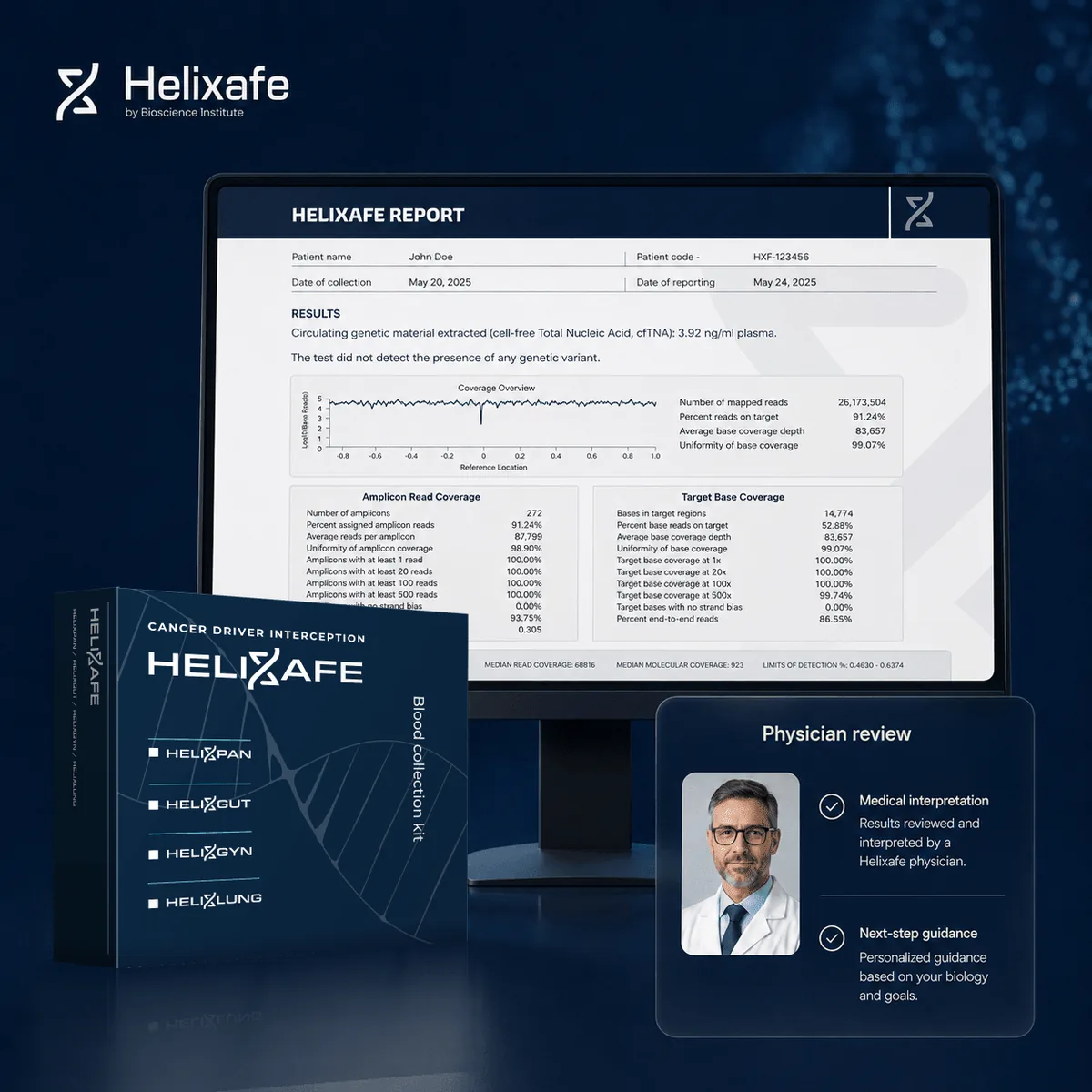
Your blood draw kit
Shipped overnight anywhere in the US, with what you need for a draw at home. Prefer a partner location? That works too.
Laboratory analysis
Your cell-free DNA is read with next-generation sequencing in a CLIA/CAP-certified laboratory, on the panel you chose.
A structured report
Within 8 weeks: which acquired changes are present in the genes your application reads, and how strong each signal is.
Physician and genomic counselor review
Bioscience Institute physicians and genomic counselors review your result and explain it against your personal and family history.

What HELIXAFE is not
- Not a replacement for any exam. Keep every recommended screening and follow-up, exactly as scheduled.
- Not a cancer verdict. A result does not tell you whether you have cancer; it is information your physicians help you use.
- Not a look at what you inherited. It reads changes acquired during life, not the variants you were born with.
- Not for under-18s or without a prescription. For adults 18 and over, prescribed and reviewed by Bioscience Institute physicians.
Questions people ask
Does HELIXGYN replace my mammogram or breast MRI?
No. Keep every mammogram, breast MRI, ultrasound and oncology visit exactly as scheduled. Imaging shows tissue; HELIXGYN reads acquired changes in your blood. It adds a reading between appointments. Whatever it shows, your imaging plan stays as it is unless your own doctors change it.
I already know my BRCA status. What does HELIXGYN add?
Your BRCA1, BRCA2 or PALB2 result tells you what you inherited, and it never changes. HELIXGYN does not look at it again. It reads the changes your cells acquire during life, test after test. Your inherited result explains why you pay attention; HELIXGYN shows what is changing now.
What is ESR1, and why does it matter after breast cancer?
ESR1 is the gene for the estrogen receptor, the target of hormone therapies such as tamoxifen and aromatase inhibitors. Certain ESR1 changes are linked to resistance to those therapies. HELIXGYN follows ESR1 over time. If a change appears, our physicians explain it and tell you what to raise with your oncologist.
Can HELIXGYN help between scans after ovarian cancer?
Yes, that is one of the situations it was built for. After high-grade serous ovarian cancer, HELIXGYN follows TP53 and the other drivers on its panel between your CA-125 tests, scans and visits. It works next to your gynecologic oncologist's plan and changes none of it.
What does a positive HELIXGYN result mean?
It means acquired changes were found in one or more of the genes HELIXGYN reads, with a measure of how strong each signal is. That is not the same as having cancer. Our physicians and genomic counselors explain it against your personal and family history. If a closer look is warranted, they tell you what to discuss with your oncologist or refer you to a specialist.
I have dense breasts. Is HELIXGYN right for me?
It can be. High breast density is one of the situations HELIXGYN was built for. Keep your mammogram and any ultrasound or MRI your doctor recommends. HELIXGYN adds a reading of breast drivers in your blood between those exams. Our physician reviews your questionnaire before prescribing.
How is HELIXGYN different from my tumor markers?
Markers such as CA-125 or CA 15-3 measure proteins in your blood. HELIXGYN reads DNA: acquired changes in the genes that drive breast and gynecologic cancers. They answer different questions. Keep every marker test your oncologist orders; HELIXGYN replaces none of them.
The science behind it
HELIXAFE grows out of Bioscience Institute's work on cell-free DNA, the small fragments of DNA that cells release into the blood. Its peer-reviewed research on cell-free DNA in healthy people, published in 2019, underpins how HELIXAFE reads acquired changes. The platform is patent-protected, and every sample is analyzed in a CLIA/CAP-certified laboratory.
For healthcare professionals
Request the clinician briefPanel specifications and clinical indications for each application, for physicians and genetic counselors.
Patient? Switch viewHELIXGYN is a dedicated monitoring tool for evaluating genomic alterations associated with increased breast and ovarian cancer risk in women with specific hereditary or hormonal risk factors.
HELIXGYN is specifically designed for women who carry pathogenic variants in the BRCA1 or BRCA2 genes, placing them at a significantly elevated lifetime risk of developing breast or ovarian cancer. This test provides a targeted surveillance strategy by monitoring somatic alterations whose early identification may support more informed proactive or clinical decisions.
HELIXGYN is also indicated for women exposed to additional hormonal risk factors—such as hormone replacement therapy (HRT), long-term use of hormonal contraceptives, or ovarian stimulation—conditions known to influence genomic stability. By integrating molecular analysis with individual risk history, HELIXGYN offers a precise, evidence-based approach to early and personalized interception.
Indications
The HELIXGYN interception program is recommended for all women:
- who are familiar with the mutation in the BRCA 1 and BRCA 2 genes, and therefore are at greater risk of developing breast or ovarian cancer;
- who are taking (or have taken) hormone replacement therapy (HRT) or hormonal contraceptives;
- who have undergone ovarian stimulation.
What the test evaluates
HELIXGYN evaluates the genetic stability and therefore the safety conditions in which hormonal therapies are carried out by monitoring the frequencies of somatic mutations in the genome, with special attention for the alterations more sensitive to that type of stimulation. Before starting any hormonal therapy, it would therefore be advisable to start a monitoring program, with annual repetition, of the mutational profile.
| 10 Genes | 157 HOTSPOTS |
|---|---|
| AKT1 FBXW7 EGFR KRAS ERBB2 PIK3CA ERBB3 SF3B1 ESR1 TP53 |
PIK3CA: E545K and H1047R AKT1: E17K ESR1: Mutations associated with anti estrogen resistance ERBB3: Mutations associated with loss of function ERBB2: Mutations associated with sensitivity to anti-ERBB2 therapies |
An innovative model
HELIXGYN represents a modern, evidence-based approach to breast and ovarian cancer interception, focusing on the objective evaluation of somatic mutations rather than relying solely on hereditary or family-based risk assessments. By applying liquid biopsy and advanced Next Generation Sequencing (NGS) technologies, the test identifies and quantifies acquired mutations that may signal early genomic alterations associated with hormone-sensitive gynecologic tumors.
Its real strength lies in the possibility of repeating the analysis annually, allowing continuous monitoring of mutation dynamics over time. By comparing data year after year, HELIXGYN offers a dynamic assessment of genomic stability in women at increased gynecological risk, facilitating the early interception of emerging alterations and supporting more accurate and personalized proactive strategies.
How the test is performed
Bioscience Institute offers pre-test advice and provides all useful information about the interception program and the execution of the HELIXGYN test.
The test involves a simple blood sample that can be performed at one of our reference centers or through your doctor.
The Bioscience Institute laboratories extract the DNA present in the sample and sequence it using the advanced Next Generation Sequencing (NGS) techniques. The subsequent bioinformatics analysis allows the determination of the presence of any mutations in the genes under examination.
Test results are available in approximately 30 days.
Scientific content reviewed by the Bioscience Institute Scientific Board. · Last updated
The information on this page is for general education and does not replace a consultation with a physician.