




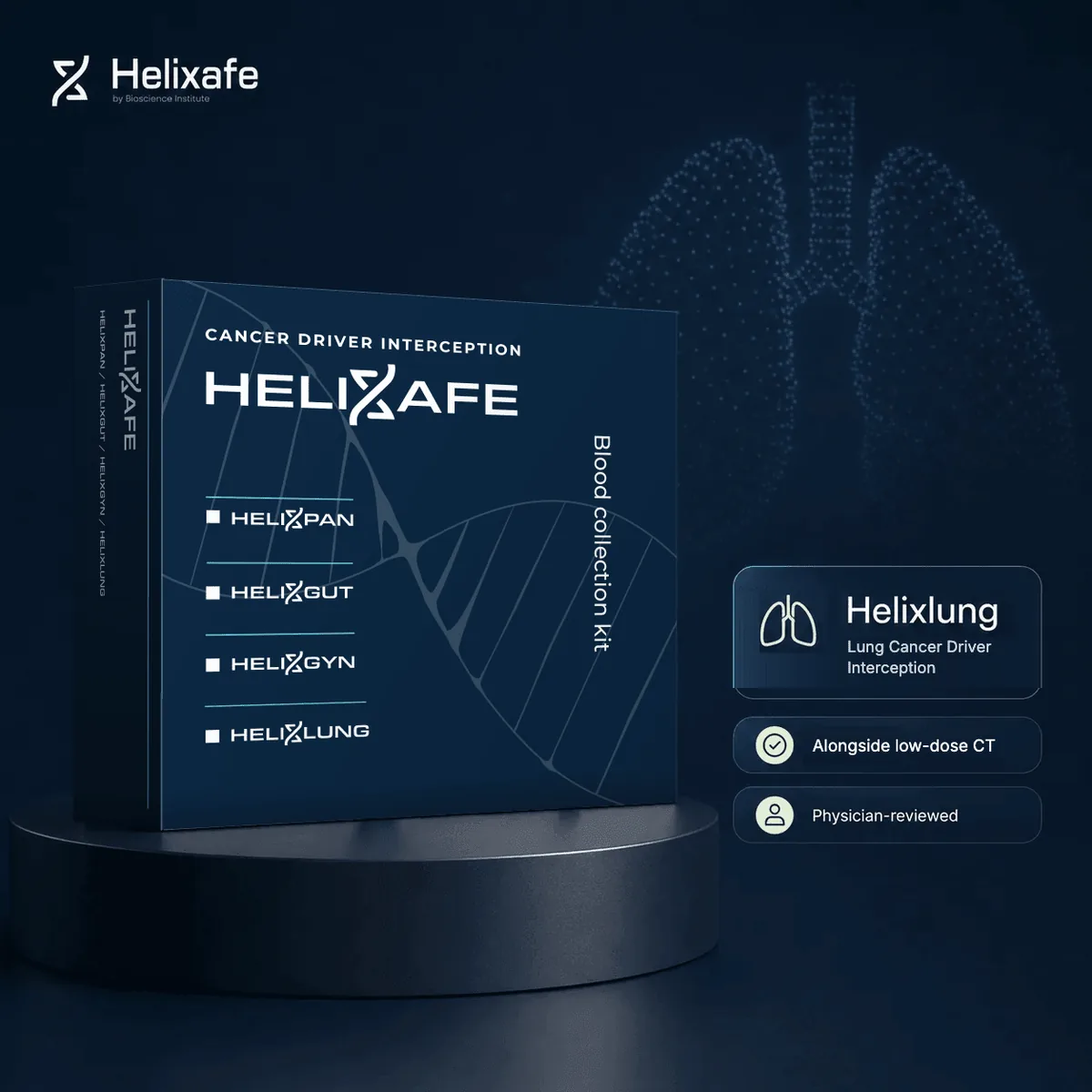
Lung Cancer Driver Interception
HELIXLUNG
Available in the US from October 16
- Prescribed and reviewed by physicians
- Home kit or partner location
- Your report within 8 weeks, explained
After lung cancer, or with a nodule under watch: see what is changing in your blood between CT scans.
HELIXLUNG is a physician-guided blood test that follows the main lung cancer drivers in the cell-free DNA of your blood. It is for people who came through lung cancer, people with a lung nodule under follow-up, and current or former smokers. It works between one CT scan and the next, and replaces none of them.
Is HELIXLUNG for you?
HELIXLUNG is for people whose lungs already have a reason to be watched. Each situation below is one it was built for.
I came through lung cancer
Your CT scans continue on your oncologist's schedule. Between them, HELIXLUNG reads the main lung drivers in your blood, so the months before a scan hold more than waiting.
A nodule on my CT is being followed
Your nodule is watched with repeat CT. HELIXLUNG adds a reading of the lung drivers in your blood in the interval. What the nodule is stays a question for your imaging.
I smoke, or I used to
Quit last year or decades ago, on a low-dose CT program or not: HELIXLUNG follows the lung drivers your smoking history makes relevant.
I was exposed at work or where I live
Workplace dust or fumes, radon at home, years of polluted air: HELIXLUNG reads the lung drivers in your blood alongside the checks your doctor advises.
I live with COPD
COPD keeps your lungs under regular review. HELIXLUNG adds a reading of the lung cancer drivers in your blood between your pulmonologist's visits.
Lung cancer runs in my family
Family history is a reason to stay alert. HELIXLUNG shows what is changing in your own lung biology now, one reading after another.
A third question
Two kinds of test are familiar. One tells you what you inherited. The other looks for cancer that is already there. HELIXAFE sits between them and asks something neither was built to answer.
- Hereditary testing
What did I inherit?
Reads the variants you were born with, such as BRCA1 or Lynch syndrome genes. The answer is fixed for life, so it is usually tested once.
- HELIXAFE
What is changing now?
Reads acquired driver changes in your blood, then reads them again, so you get a reference first and a direction after.
- Screening
Is there cancer to find?
Mammograms, colonoscopies, CT scans and other exams look for cancer, or precancer, that is already there.
How it works
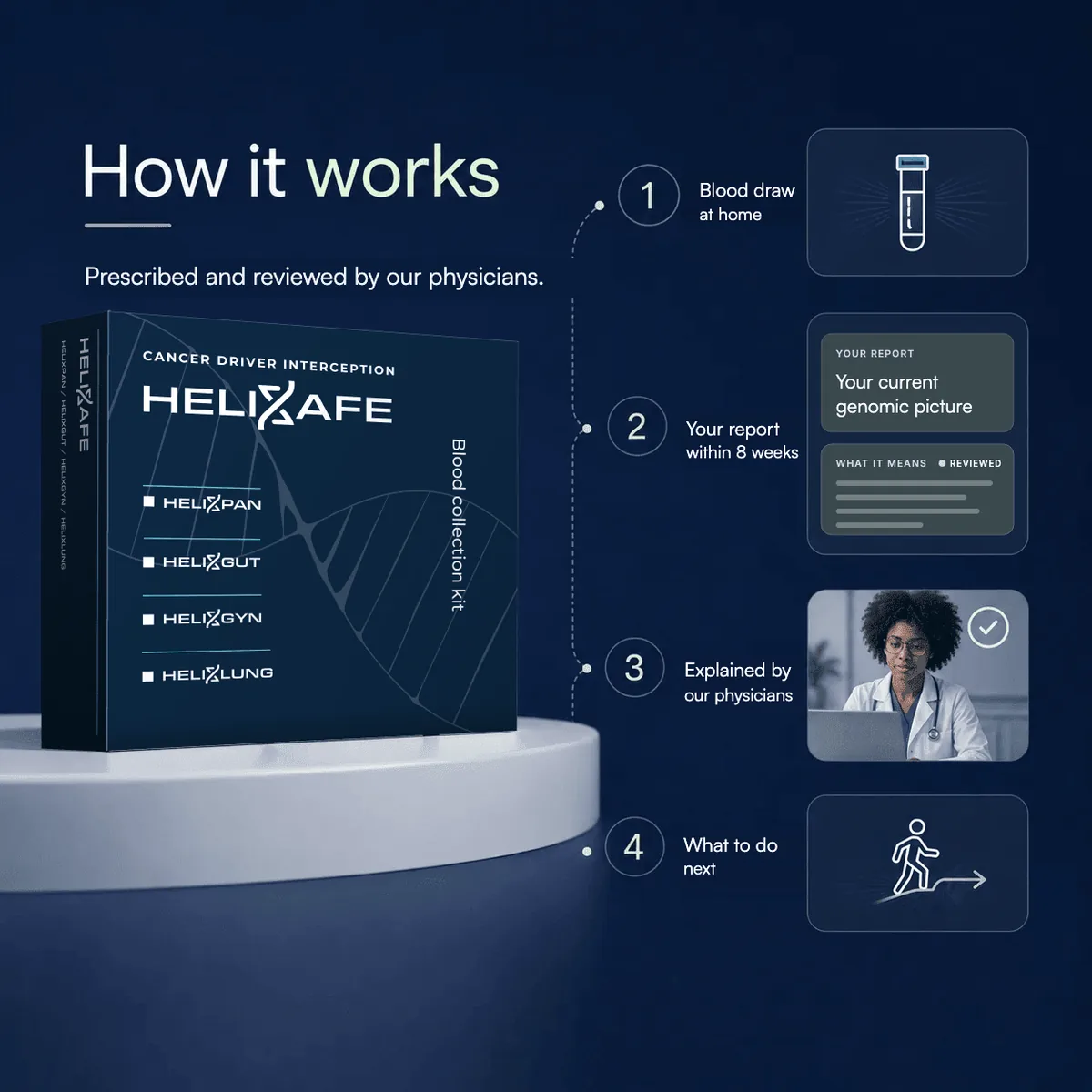
- 1
Answer a short questionnaire
Choose your application, then share your health and family history in a short online questionnaire.
- 2
A physician prescribes
A Bioscience Institute physician reviews your answers and, if the test fits, prescribes it. Your kit ships overnight.
- 3
One blood draw
Use the kit at home, or visit a partner location. The sample then travels to a CLIA/CAP-certified laboratory.
- 4
Your report, explained
Within 8 weeks, with physicians and genomic counselors who explain each finding and what comes next.
What HELIXLUNG follows
Cancer drivers are gene changes that can push a cell toward cancer. HELIXLUNG reads 11 genes at 169 mutational hotspots, covering the drivers most often found in lung cancer, including those that guide targeted treatment. Our physicians put every name in plain words.
- EGFR, including resistance changes
- A frequent driver in people who never smoked, and the gene where resistance to some targeted drugs can appear.
- KRAS, BRAF and MET
- Growth-signal genes that can drive lung tumors, including the KRAS G12C and BRAF V600E changes.
- ALK, ROS1, RET and NTRK
- Genes that can break and join a partner gene, locking growth on. Less common than EGFR or KRAS, and on the panel.
- TP53, read end to end
- A tumor suppressor gene that acts as a brake on damaged cells. HELIXLUNG reads its full length, not just a few spots.
- Real signal, not noise
- A confirmation step helps set a genuine signal apart from background before a result is reported to you.
The first HELIXLUNG test sets your reference. Each repeat test, through Continue Interception, is read against it, so you see direction rather than a single snapshot. Stable is a result in its own right. Movement is a reason for a conversation with your physicians, not a verdict.
Between one CT and the next
Low-dose CT, follow-up CT and PET-CT show your lungs in images. They look for a nodule or a tumor that is already there, and HELIXLUNG replaces none of them. It works in the months between scans, reading what is changing in your blood, so your next appointment starts with more than a wait. Keep every recommended screening and follow-up, exactly as scheduled.
What you receive
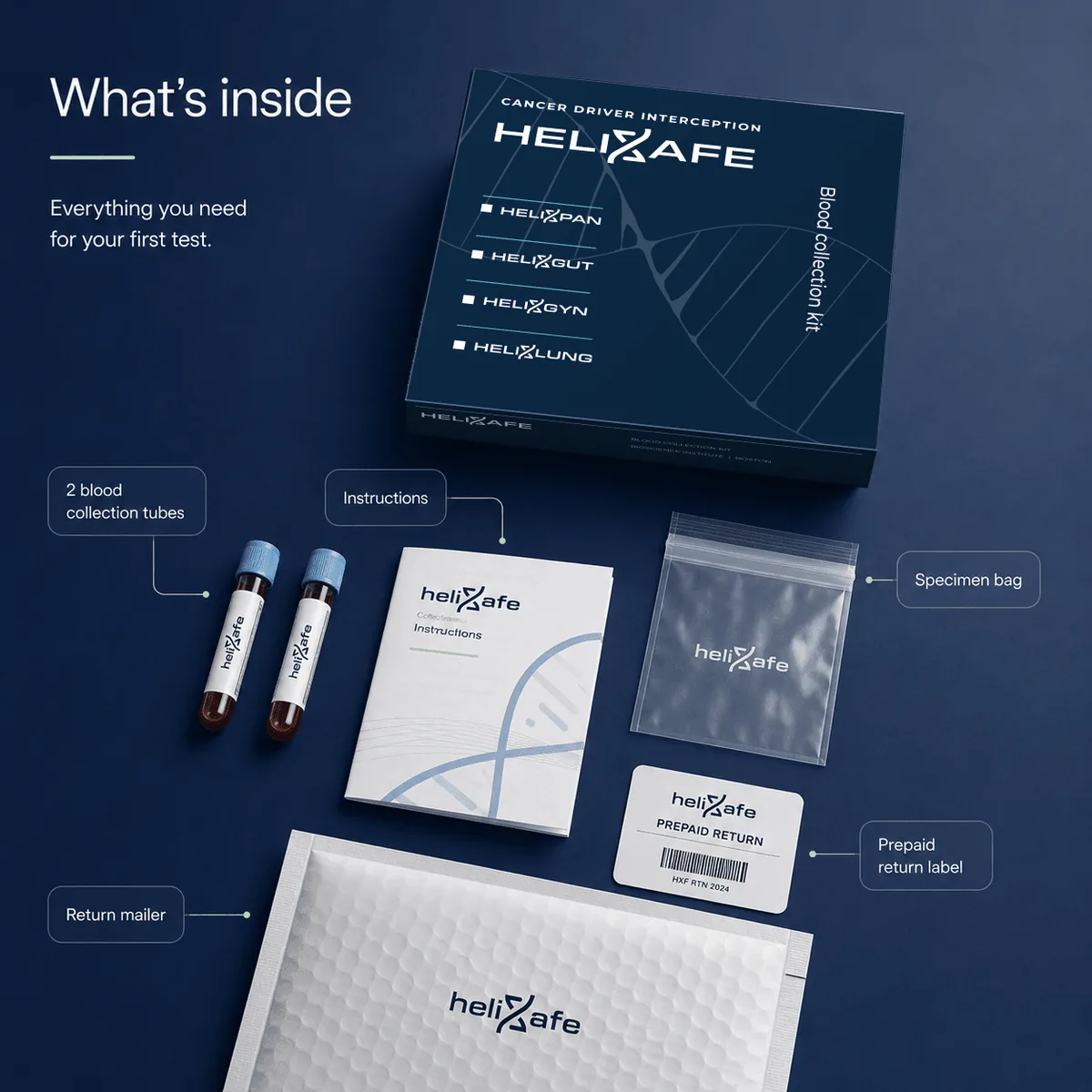
Your blood draw kit
Shipped overnight anywhere in the US, with what you need for a draw at home. Prefer a partner location? That works too.
Laboratory analysis
Your cell-free DNA is read with next-generation sequencing in a CLIA/CAP-certified laboratory, on the panel you chose.
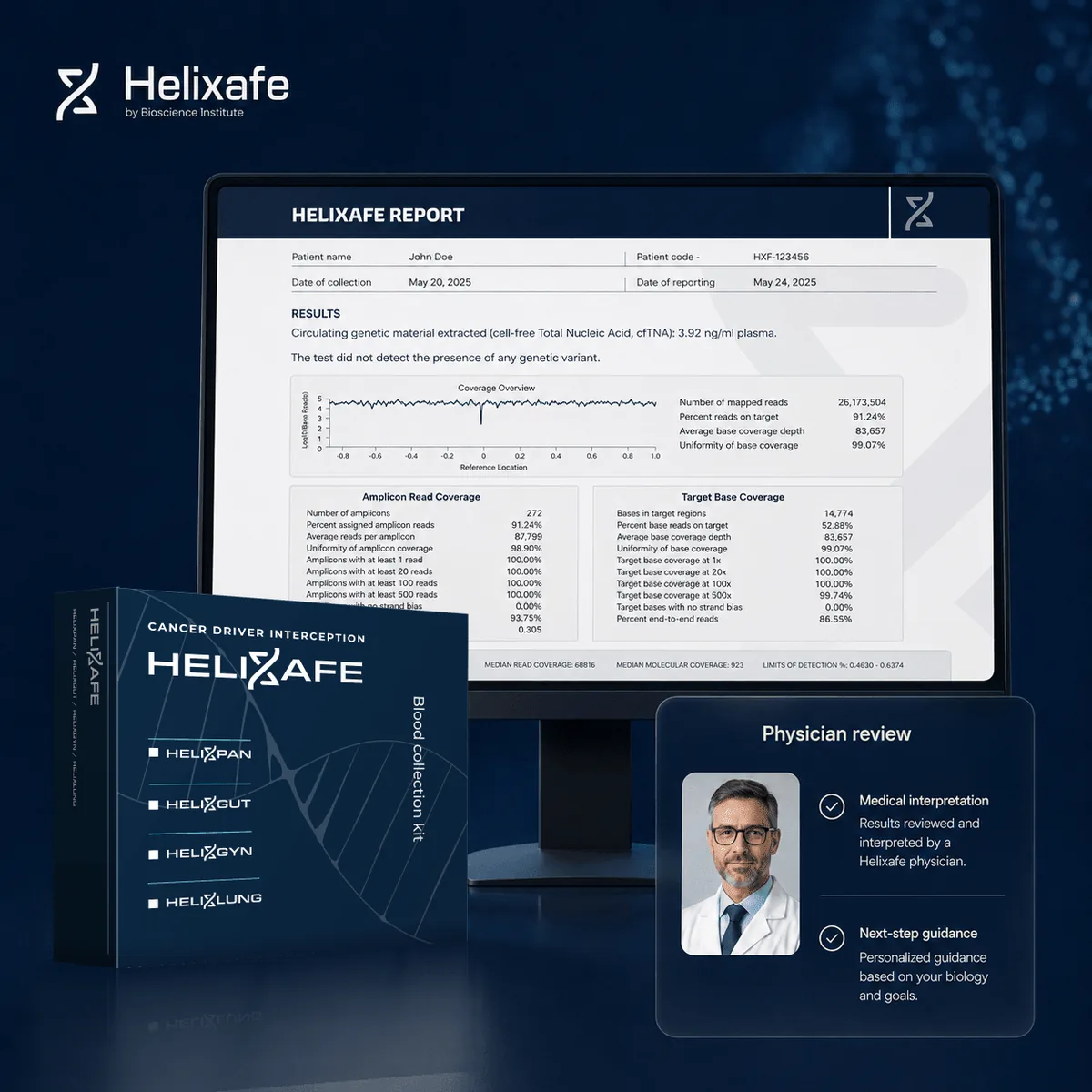
A structured report
Within 8 weeks: which acquired changes are present in the genes your application reads, and how strong each signal is.
Physician and genomic counselor review
Bioscience Institute physicians and genomic counselors review your result and explain it against your personal and family history.
What HELIXAFE is not
- Not a replacement for any exam. Keep every recommended screening and follow-up, exactly as scheduled.
- Not a cancer verdict. A result does not tell you whether you have cancer; it is information your physicians help you use.
- Not a look at what you inherited. It reads changes acquired during life, not the variants you were born with.
- Not for under-18s or without a prescription. For adults 18 and over, prescribed and reviewed by Bioscience Institute physicians.
Questions people ask
Does HELIXLUNG replace my CT scan or low-dose CT?
No. Keep every CT, low-dose CT and PET scan exactly as scheduled. Scans show what a nodule or a tumor looks like; a blood test cannot. HELIXLUNG reads what is changing in your blood between those scans and gives you and your physicians one more piece of the picture.
Can HELIXLUNG help with lung nodule follow-up?
It sits beside it. Your nodule is followed with repeat CT at intervals your doctor sets, and that does not change. HELIXLUNG adds a reading of the lung cancer drivers in your blood in between. It cannot tell you whether a nodule is harmless. Your imaging and your doctors answer that.
I dread every scan. Can HELIXLUNG help with scanxiety?
It cannot take the scan's place, and it will not make the wait disappear. What it adds is a reading between scans, explained by a physician, so the scan is no longer the only moment you hear about your lungs. A trend line, read with someone who knows your history, can make the months in between feel less blank.
I quit smoking years ago. Is HELIXLUNG still relevant?
It can be. Former smokers are one of the groups HELIXLUNG was built for. Our physician reviews your questionnaire, including how long and how much you smoked, before prescribing. If you are eligible for low-dose CT, keep it: HELIXLUNG works alongside it.
What does a positive HELIXLUNG result mean?
It means acquired changes were found in one or more genes on the panel, with a measure of how strong each signal is. That is not the same as having cancer. Our physicians and genomic counselors explain it against your history. If a closer look is warranted, they tell you what to discuss with your pulmonologist or oncologist, or refer you to a specialist.
Does HELIXLUNG read EGFR, ALK and KRAS?
Yes. Its 11 genes and 169 hotspots include EGFR with its resistance changes, ALK, ROS1, RET, NTRK, MET, KRAS G12C, BRAF V600E and TP53. After lung cancer, these are often the names already in your pathology report. HELIXLUNG does not choose or change treatment; your oncologist does.
I never smoked. Can HELIXLUNG still fit me?
It can. Lung cancer also affects people who never smoked, and radon, air pollution and workplace exposures play a part. A family history, COPD or a nodule under follow-up are reasons too. Our physician reviews your questionnaire and decides with you.
The science behind it
HELIXAFE grows out of Bioscience Institute's work on cell-free DNA, the small fragments of DNA that cells release into the blood. Its peer-reviewed research on cell-free DNA in healthy people, published in 2019, underpins how HELIXAFE reads acquired changes. The platform is patent-protected, and every sample is analyzed in a CLIA/CAP-certified laboratory.
For healthcare professionals
Request the clinician briefPanel specifications and clinical indications for each application, for physicians and genetic counselors.
Patient? Switch viewHELIXLUNG is a targeted genomic interception tool designed to identify early molecular signs of cancer risk in smokers and individuals exposed to significant air pollution.
HELIXLUNG is a targeted genomic tool for Lung Cancer Interception, specifically designed for smokers and individuals exposed to significant air pollution. It focuses on identifying early molecular alterations that may signal an increased risk of developing tumors of the respiratory system.
The program analyzes somatic mutations in genes directly involved in lung carcinogenesis. Chronic exposure to tobacco smoke and airborne pollutants induces cumulative DNA damage which, when no longer properly repaired, leads to an increased mutation burden and progressive genomic instability. This instability is a measurable biomarker of the prodromal phase—the asymptomatic stage that precedes tumor development. By identifying and quantifying these alterations, HELIXLUNG enables early interception and supports a personalized strategy for Lung Cancer Interception in high-risk individuals.
Indications
HELIXLUNG is recommended for individuals who fall into one or more of the following risk categories:
- Active smokers, regardless of age or smoking history.
- Heavy smokers (≥20 cigarettes/day or ≥20 pack-years).
- Former smokers, especially those who quit within the last 15 years or with a significant cumulative exposure.
- Individuals exposed to second-hand smoke in domestic, social, or occupational environments.
- People living in high-pollution areas, particularly with chronic exposure to PM2.5 or combustion-derived pollutants.
- Workers exposed to airborne carcinogens, such as asbestos, silica, diesel exhaust, solvents, or industrial fumes.
- Individuals with a family history of lung cancer or other cancers associated with tobacco-related mutational signatures.
- People with chronic respiratory conditions, such as COPD or chronic bronchitis, where genomic instability may be amplified by inflammation.
- Individuals seeking a proactive strategy for Lung Cancer Interception through the monitoring of somatic mutations.
What the test evaluates
HELIXLUNG allows smokers and individuals exposed to air pollution to undergo yearly molecular monitoring to ensure that smoke-related damage to the body is kept under control. The damage becomes evident at the genetic level as an increase in the mutation frequencies of specific genes linked to the respiratory system. By analysing this mutational profile, it is possible to intercept cancers of the respiratory tract in their prodromal, asymptomatic phase, when interception strategies are most effective.
| 11 Genes | ||
|---|---|---|
| ALK | KRAS | PIK3CA |
| BRAF | MAP2K1 | ROS1 |
| EGFR | MET | TP53 |
| ERBB2 | NRAS | |
| 169 HOTSPOT | |
|---|---|
| EGFR: | T790M, L858R, Exon19 del, C797S |
| KRAS: | G12X, G13X, Q61X |
| ALK: | I1151 Tins, L1152R, C1156Y |
| BRAF: | V600E |
An innovative model
HELIXLUNG represents a modern approach to Lung Cancer Interception, based on the objective evaluation of somatic mutations induced by tobacco smoke and airborne pollutants rather than on subjective or family-based risk assessments. Using liquid biopsy and advanced Next Generation Sequencing (NGS), the test identifies and quantifies acquired mutations that may signal early genomic instability—one of the earliest measurable indicators in the development of respiratory system cancers.
The true strength of HELIXLUNG lies in its annual repetition, which enables continuous monitoring of mutation frequencies over time. By comparing molecular data year after year, the test provides a dynamic assessment of genomic stability in individuals exposed to smoke or pollution, facilitating the early interception of emerging alterations and supporting a more precise and personalized proactive strategy.
How the test is performed
Bioscience Institute offers pre-test advice and provides all useful information about the interception program and the execution of the HELIXLUNG test.
The test involves a simple blood sample that can be performed at one of our reference centers or through your doctor.
The Bioscience Institute laboratories extract the DNA present in the sample and sequence it using the advanced Next Generation Sequencing (NGS) techniques. The subsequent bioinformatics analysis allows the determination of the presence of any mutations in the genes under examination.
Test results are available in approximately 30 days.
Scientific content reviewed by the Bioscience Institute Scientific Board. · Last updated
The information on this page is for general education and does not replace a consultation with a physician.